
SWING – School on Internet Governance 2026

SWING – School on Internet Governance 2026
April 20 - April 24
To apply, applicants are asked to submit
- Curriculum Vitae (CV)
- Completed application/registration form (template/model)
- Copy of a valid ID document (passport or national identity card)
- Proof of payment of the participation fee (receipt/confirmation)
by 27th February 2026.
2026 Theme: Digital Sovereignty
The 2026 edition will focus on Digital Sovereignty — a timely and fast-evolving concept at the crossroads of Internet governance, geopolitics, economics, innovation, and fundamental rights. Broadly speaking, digital sovereignty concerns the ability of states, regions, organisations, communities, and individuals to make autonomous choices in the digital sphere: how data is generated, stored, accessed, and governed; how critical infrastructures are built, secured, and maintained; how strategic technologies are developed and regulated; and how dependencies on external actors are managed.
Across the week, participants will examine digital sovereignty both as a policy objective (resilience, security, competitiveness, strategic autonomy) and as a normative challenge (openness and interoperability of the Internet, human rights protections, inclusive governance, and international cooperation). Particular attention will be devoted to concrete domains where sovereignty claims are most visible — from cybersecurity and AI to semiconductors, undersea cables, and satellite infrastructures — and to the trade-offs that emerge between protection, innovation, and openness.
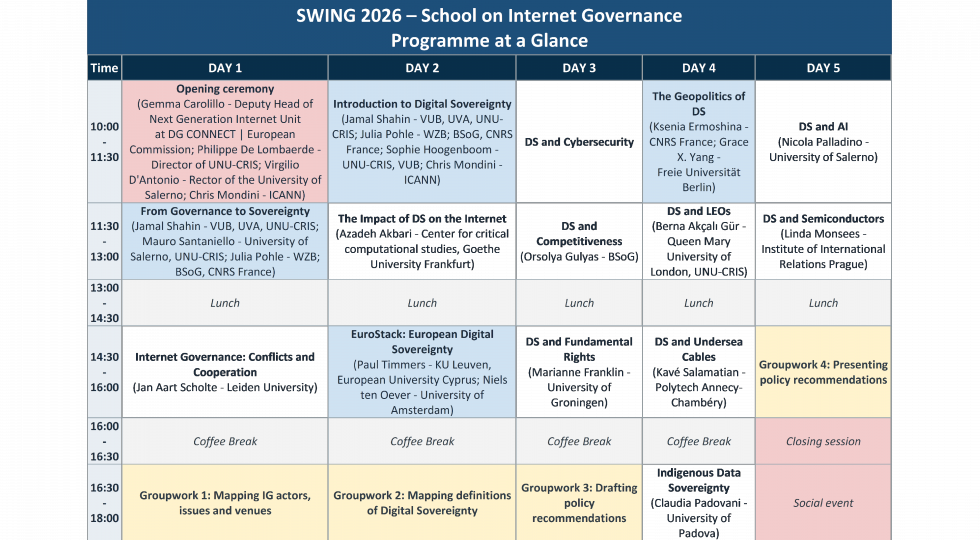
Lectures and seminars will be delivered by internationally renowned scholars and experts, combining academic depth with policy relevance and practical insight. The programme also includes interactive group work throughout the week, culminating in policy recommendations presented during the final sessions.
For further information about the School and registration, please see the official website or contact Sophie Hoogenboom at shoogenboom@cris.unu.edu.